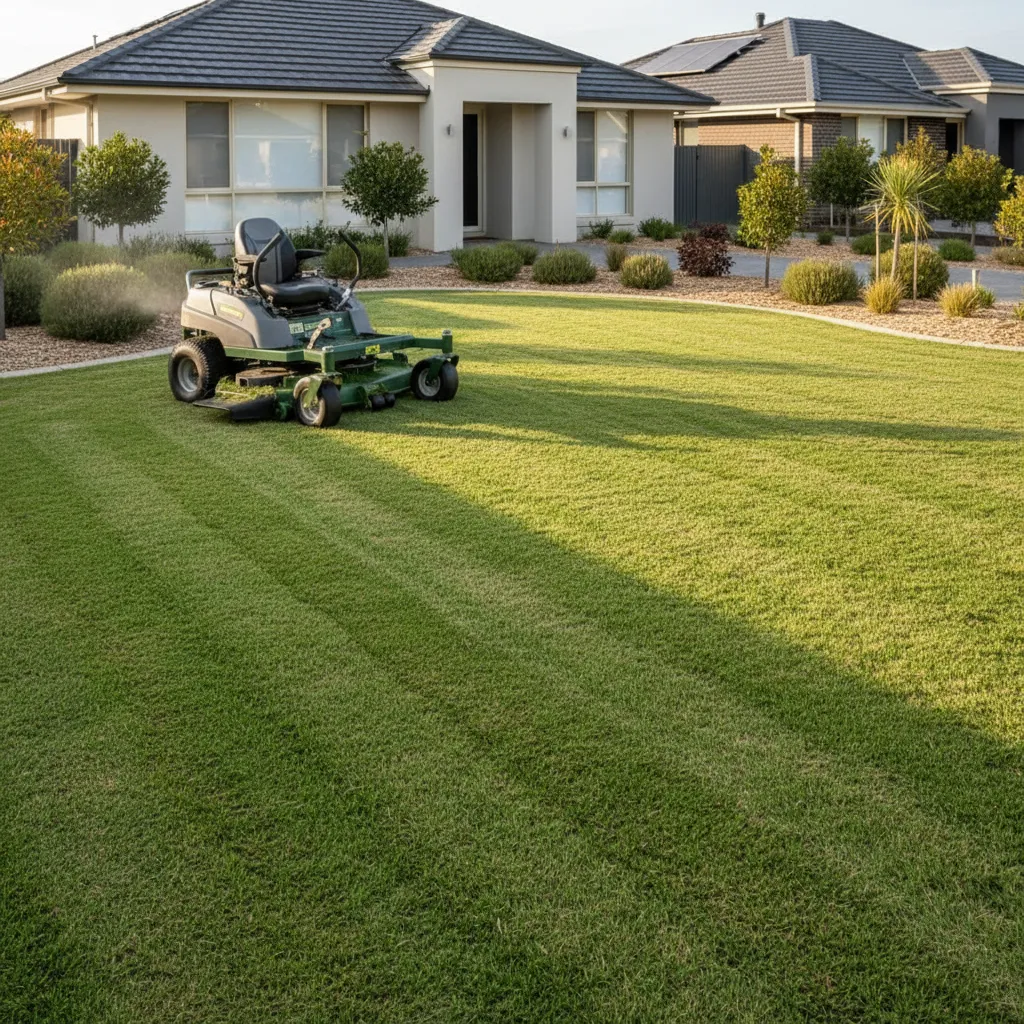
Lawn Mowing Hourly Rate NSW — How Mowing Work Is Actually Charged
Most NSW operators do not charge by the hour. Here is what actually sets the rate on a mowing job, and how to compare two quotes without getting caught out.
Hourly Rate or Per Job? The Short Answer
People search for a lawn mowing hourly rate in NSW because they want a benchmark before they call anyone. The honest answer is that an hourly figure is the wrong unit for most mowing work, and very few established operators in New South Wales use it.
Mowing is a defined, repeatable job. An operator who has seen a few thousand lawns can look at a property and know within a few minutes how long it will take. Because they can predict it, they can quote it as a fixed figure — and once it is fixed, the risk of the job running long sits with them rather than with you. That is the practical advantage of per-job quoting, and it is why it has become the norm.
Hourly arrangements still make sense where the scope genuinely cannot be defined in advance: a full garden tidy-up, clearing an overgrown block, or a day of mixed maintenance where nobody can say at the start exactly what will be done. If someone quotes you an hourly rate for a straightforward suburban mow, it is worth asking why, and worth asking what happens if the job takes longer than they expected.
Jay Pro quotes per job. Call 0468 049 230 or request a free quote online — we will give you an exact price for your property before any work begins.
What Actually Drives the Rate on a Mowing Job
Two houses on the same street can quote very differently, and it is rarely about the size of the block alone. These are the eight things an operator is weighing up when they give you a number.
Lawn area
The single biggest driver. It is not just the footprint — it is how much of it is open, mowable turf versus garden bed, path and paving. A block that looks large on a title plan can be a short job if half of it is decked or planted out.
Access
Whether a ride-on or only a push mower fits through the side gate changes the labour on a large block dramatically. Narrow gates, tight corners, stairs to a rear yard, locked side access and steep driveways all add time.
Grass height at the visit
A lawn cut on a regular cycle takes one pass. A lawn that has run away over a wet Sydney summer often needs a high pass, a second lower pass and far more clean-up. This is why the first cut on a neglected lawn is usually quoted separately from the ongoing cycle.
Grass type and condition
Established kikuyu and buffalo are dense and heavy to cut; couch and fine fescue are lighter. Wet, thatchy or weed-choked turf loads the machine and slows the job. Persistent thatch is a separate problem worth solving on its own.
Slope and terrain
Embankments, retaining-wall verges and steep rear yards cannot be mowed with the same machinery or at the same speed as flat turf. Anything that has to be done on foot with a line trimmer is slower than anything that can be ridden or pushed.
Clippings volume and what happens to them
Mulching clippings back into the lawn costs nothing to remove. Catching and leaving them in your green bin is fine for a routine cut. A first cut on a long lawn can produce far more than a green bin holds, and removing that volume off site is real work that has to be accounted for.
Edging, trimming and blow-down
Some operators quote a bare mow and charge for edges separately. Edging along paths, driveways and garden borders, trimming around obstacles, and blowing down hard surfaces are what make a lawn look finished. Always check whether they are in the number you were given.
Frequency and one-off versus regular
A regular cycle is cheaper per visit than an equivalent one-off, because the lawn never gets away and each visit is shorter and more predictable. A single one-off cut carries the full travel and set-up cost on its own.
How Quoting Works in Practice
For a standard suburban lawn, a quote takes one phone call. We will ask what the lawn area is roughly, whether you want front, back or both, how wide the side access is, roughly how long the grass is right now, and whether you want the clippings taken away. That is usually enough to give you a firm figure on the spot.
For anything larger or more awkward — acreage, a steep block, a strata common area, a commercial site with multiple buildings — we will arrange to look at it before quoting. Guessing at a property we have not seen helps nobody: it leads either to an inflated quote that protects us, or to an optimistic one that has to be revised on the day. Neither is a good outcome for you.
Where a lawn has been left a long time, we quote the restoration cut and the ongoing cycle as two separate figures. The first visit on a badly overgrown lawn is genuinely a different job — often a high pass followed by a lower one, with far more material to deal with. Quoting it as though it were a routine cut would be misleading, and quoting the routine cuts at restoration prices would be worse.
Once the figure is agreed, it holds. If something turns up that was genuinely outside what we were told — a second lawn area we were not shown, or grass at knee height when it was described as slightly long — we stop and re-quote before doing the work, not after. That conversation happens before the invoice, every time.
How to Compare Mowing Quotes Fairly
The cheapest number is not always the cheapest job. Most of the time a large gap between two quotes means they are not quoting the same work. Six questions will tell you which it is.
Make sure everyone is quoting the same job
Ask each operator explicitly whether the figure includes edging, trimming around obstacles, blow-down of paths and driveways, and removal of clippings. A quote that excludes three of those four is not comparable to one that includes them, no matter which number is lower.
Separate the first cut from the ongoing cycle
If your lawn is overgrown, the restoration visit and the maintenance visits are two different jobs. Ask for both to be quoted so you know what the ongoing commitment actually looks like once the lawn is back under control.
Ask what happens if the job runs long
This is the practical difference between hourly and per-job. On an hourly arrangement, an unexpectedly heavy cut costs you more. On a fixed per-job quote, it does not. Get the answer before the work starts, not after.
Check for call-out, travel and minimum charges
Some quotes are quiet about a minimum job value or a call-out fee that applies on top. A small courtyard can end up costing the same as a much larger lawn once a minimum is applied, so it is worth asking directly.
Confirm the operator carries public liability insurance
Mowers throw debris and line trimmers mark render and paintwork. An uninsured operator is a risk you carry, and it is a fair question to ask before anyone starts a machine on your property.
Get the quote in a form you can refer back to
A verbal number remembered differently by two people is the most common cause of a dispute at the end of a job. A written or texted confirmation of scope and price removes the argument entirely.
What No Hidden Fees Means Here
It is an easy phrase to put on a website, so it is worth being specific about what it commits us to. Every Jay Pro mowing visit includes the mow, edging along paths, driveways and garden borders, trimming around trees, posts and fence lines, and a blow-down of every hard surface we have walked over. Those are not line items you can decline to make the figure smaller, and they are not extras added at the end to make it larger. They are what a finished lawn requires.
There is no call-out fee on top of the quote and no travel surcharge for suburbs we service. There is no premium for booking a single cut rather than a cycle, though a regular cycle does work out better per visit for the reasons above. And the figure does not move because a job took twenty minutes longer than we thought — that is our problem to absorb, which is exactly what fixed quoting is for.
We are licensed and insured, which matters more than it sounds. Mowers throw stones and line trimmers mark render and paintwork. If an operator cannot answer a question about public liability cover, that is worth more attention than a small difference in price.
Frequently Asked Questions
Common questions about how lawn mowing is charged in New South Wales.
Do lawn mowing services in NSW charge by the hour or by the job?
Most established operators in NSW quote per job rather than per hour. Per-job quoting puts the risk of a job running long on the operator instead of the customer, and it means you know the figure before anyone starts. Hourly arrangements are more common for open-ended garden work — a full tidy-up, clearing, or a day of mixed maintenance — where the scope genuinely cannot be defined in advance. Jay Pro quotes per job. Call 0468 049 230 or request a free quote online and we will give you an exact price for your property before any work begins.
What makes one lawn more expensive to mow than another?
Mowable area, access, grass height at the visit, grass type, slope, and how much clipping volume has to be dealt with. Two houses on the same street can quote very differently if one has flat open turf with wide side access and the other has a steep rear yard reached through a narrow gate. Frequency matters too: a lawn on a regular cycle is a shorter, more predictable job every visit than the same lawn cut twice a year.
Why will you not publish a rate card?
Because a published figure would be wrong for most properties, and a number that is wrong is worse than no number. The honest answer is that we need to know the size, access, grass type and condition of your lawn before we can tell you what it costs. That takes a short phone call. Call 0468 049 230 or request a free quote online — we will give you an exact price for your property before any work begins.
Is a regular mowing cycle cheaper than booking one-off cuts?
Per visit, yes, and for a straightforward reason: the lawn never gets long enough to need restoration work. Each visit is one pass instead of two, there is less clipping volume to handle, and the schedule lets us plan a route efficiently. A one-off cut carries the full travel and set-up cost on a single visit, and if the lawn has been left a while it also carries the extra work of bringing it back.
What does no hidden fees actually mean in practice?
It means the figure you agree to before the job is the figure on the invoice afterwards. Edging, trimming around obstacles and blow-down of hard surfaces are part of every Jay Pro visit, not extras added later. There is no call-out fee layered on top and no travel surcharge for suburbs we service. If something genuinely outside the agreed scope comes up — an area of the yard we were not shown, or a lawn far longer than described — we tell you and re-quote before doing the work, not after.
How do I get an accurate quote without an on-site visit?
For most suburban lawns a phone call is enough. Be ready to describe the approximate size of the lawn area, whether the front, back or both need doing, how wide the side access is, roughly how long the grass is now, and whether you want the clippings taken away. For larger or unusual properties — acreage, steep blocks, commercial sites — we will arrange to look at it in person before quoting.
Do you charge extra to remove the clippings?
For a routine cut on a regular cycle, clippings are usually mulched back into the lawn or left in your green bin, and that is included. Where a first cut on a long lawn produces more volume than a green bin can take, off-site removal is real work and we will tell you up front if it applies so it is in the quote rather than a surprise. We also offer green waste removal as a standalone service.
Related Guides
Get an Exact Figure for Your Lawn
Call 0468 049 230 or request a free quote online — we will give you an exact price for your property before any work begins.
2,100+ Customers | Licensed & Insured | Same Day Service