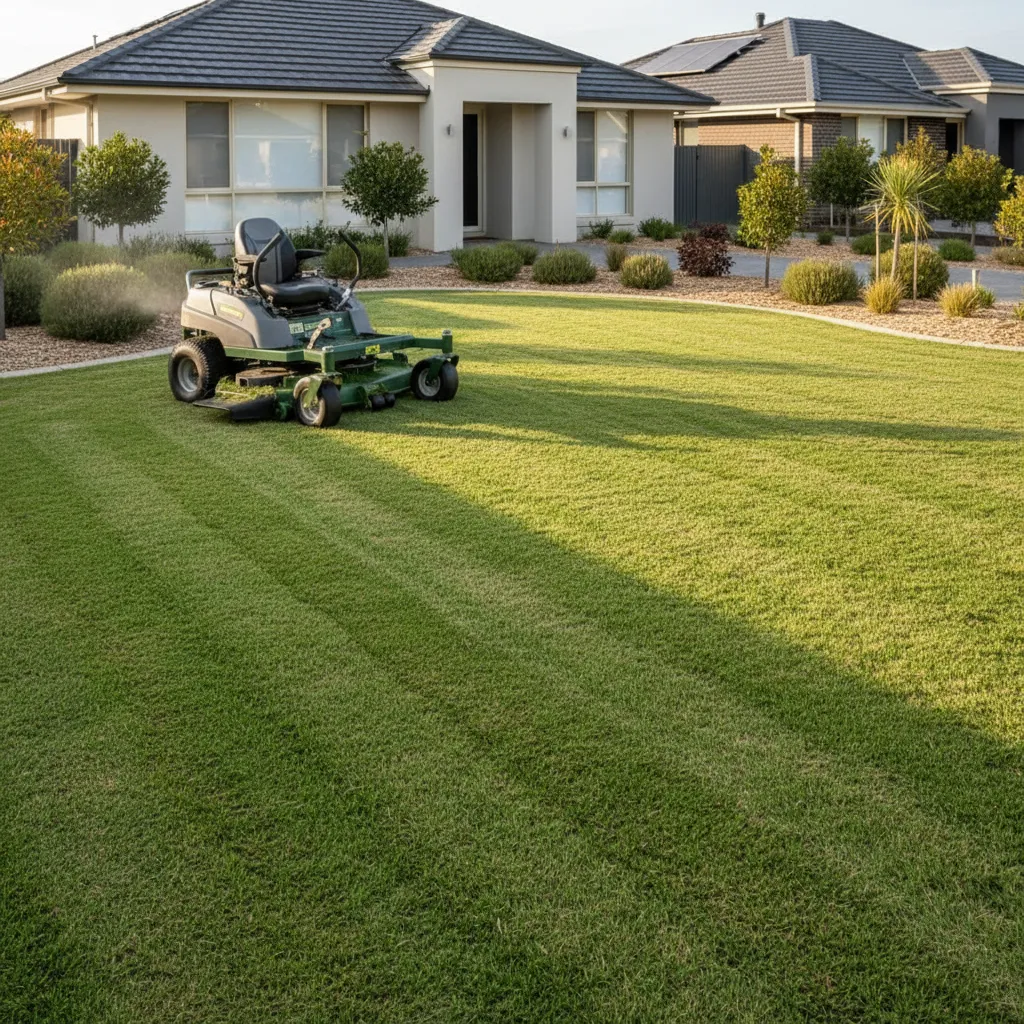
Grass Cutting Services in Sydney
Mow, edge, blow-down and clippings handled — cut at the right height for your turf type. Residential, strata and commercial, with same-day service available.
Most of what separates a good grass cutting service from a poor one happens before the mower moves. The height the blades are set to, whether those blades are sharp, and what happens to the clippings afterwards will do more for the look and health of a lawn over a season than any product you can buy. Get the height wrong and you scalp the lawn, invite weeds into the bare patches, and spend the next month watching it recover. Get it right and the lawn thickens, shades out its own weeds, and holds colour longer between visits.
Jay Pro Lawn Mowing is a locally operated crew based in Wentworthville, cutting grass across more than 250 Sydney suburbs for homes, rental properties, strata complexes, commercial sites and large rural-residential blocks. This page sets out exactly what our grass cutting service covers, how we set cutting heights for the turf types common across Sydney, how often lawns here actually need cutting through the year, and what happens when a lawn has been left far too long. If you would rather just get a price, call 0468 049 230 or request a free quote online.
What a Grass Cutting Service Includes
A complete grass cut is four jobs, not one. Skipping any of them is what makes a lawn look half-finished even when the grass itself has been cut evenly.
- The mow. Blades set to the correct height for the turf type and the season, and cut in directional passes so the finish is even rather than patchy. Slopes, uneven ground and the strips around tree roots are all worked at a consistent height instead of being dropped into.
- The edge. Line trimming along every hard edge — driveways, footpaths, garden bed borders, fence lines, retaining walls and around fixed obstacles. A ragged edge makes a perfectly cut lawn look untidy, and a crisp one makes an average lawn look sharp. Where a property has established garden bed borders or paving, we cut a defined edge rather than just knocking the growth back.
- The blow-down. Clippings blown off every hard surface before we leave — paths, driveway, patio, entry steps. Clippings left on concrete stain it, get walked inside, and wash into stormwater drains in the next rain.
- The clippings. On a lawn kept at a regular interval, clippings are short enough to be mulched back into the turf, where they return nitrogen and moisture to the soil. On a first cut, an overgrown lawn, or a wet lawn where the clippings would clump and smother the grass beneath, they are caught and removed instead. We make that call on the day based on the length and condition of the grass, not on a fixed rule.
Cutting Height by Sydney Grass Type
There is no single correct mowing height. There is a correct height for each species, and the gap between them is large enough that a setting which suits Couch will strip a Buffalo lawn back to bare runner. Sydney lawns are dominated by four warm-season turf types, with cool-season blends appearing occasionally in shaded or cooler-aspect gardens.
| Grass type | Cutting height | What to watch |
|---|---|---|
| Buffalo (Sir Walter, Palmetto, Sapphire) | 25-50mm | Never scalp. Buffalo grows from above-ground runners, and cutting into them exposes bare stem. Run at the higher end in shade and through summer. |
| Kikuyu | 20-40mm | Extremely vigorous in warm weather. Keep it shorter in spring to control the spread, slightly longer through heat. Needs cutting more often than most owners expect. |
| Couch (including Queensland Blue Couch) | 10-25mm | The one common Sydney turf that genuinely suits a short cut, but it browns fast if scalped during a heatwave. Finer cultivars take the lower end. |
| Zoysia (Nara, Empire) | 15-30mm | Slow growing and dense, so it holds a neat finish between visits. It is slow to recover from a scalping, which makes height discipline more important, not less. |
| Fescue and ryegrass blends | 35-60mm | Cool-season grasses in a warm climate. Length is what keeps the crown shaded and the soil cool, so these are cut noticeably higher than warm-season turf. |
Sitting over all of these is the one-third rule: never remove more than a third of the leaf blade in a single cut. If a Buffalo lawn is sitting at 90mm and the target is 35mm, that is not one cut, it is two or three spaced a week or two apart. The rule exists because the leaf is where the plant makes its food, and stripping most of it away in one go forces the lawn to live off root reserves.
Identifying the turf is the first thing we do at the quote, because it determines everything that follows. If you are not sure what you have, we will tell you — and if the lawn has been cut at the wrong height for a while, we will bring it back to the right range over a few visits rather than in one aggressive correction.
Why Cutting Too Short Scalps a Lawn
Scalping is the single most common cause of a lawn that looks worse after mowing than before it. Four things go wrong at once, and they compound.
First, the plant loses its leaf area. Grass photosynthesises through its blades, so a hard cut removes most of the plant's ability to feed itself and it has to draw down stored energy in the roots to push out new growth. Second, root depth follows leaf height. A lawn kept short runs a shallow root system, which means it dries out faster, wilts sooner in a Sydney summer, and needs more water to stay green. Third, bare soil is exposed to direct sunlight. Soil temperature climbs, moisture evaporates, and weed seed sitting in the top layer of soil finally gets the light it has been waiting for — which is why scalped lawns fill with bindii, winter grass and clover.
Fourth, and specific to Buffalo, the damage can be structural. Buffalo spreads by stolons, runners that sit on top of the soil rather than beneath it. Cutting below the leaf into those runners removes the growing points, and what is left behind is a mat of brown stem with nothing to regrow from. That is the classic hard-cut Buffalo lawn that stays patchy and brown for months. A lawn scalped in the middle of a hot week may not recover until the following growing season.
How Often Sydney Lawns Need Cutting
Sydney's warm temperate climate keeps warm-season turf growing for most of the year, with a genuine slowdown only through the coldest weeks. The right interval is the one that lets you take the lawn back to its target height without breaking the one-third rule, which means the interval changes with the season rather than staying fixed.
| Season | Typical interval | Notes |
|---|---|---|
| September - November | Every 7-14 days | Spring flush. Growth accelerates quickly and this is when lawns most often get away from their owners. |
| December - February | Every 7-10 days (Kikuyu weekly) | Peak growth in warm, humid weather. Cutting height goes up, not down, to shade the soil. |
| March - May | Every 14-21 days | Growth tapers as nights cool. A good window to correct height gradually before winter. |
| June - August | Every 3-6 weeks | Couch goes semi-dormant. Buffalo and Kikuyu slow but keep growing, so a monthly tidy is usually enough. |
Two local factors shift these intervals. Irrigated and fertilised lawns grow faster and need a shorter interval than the table suggests. Shaded lawns and those on heavy Western Sydney clay grow more slowly and can stretch it. Rain matters more than the calendar: a wet fortnight in October will put on more growth than a dry month in March.
What Happens With a Badly Overgrown Lawn
A lawn that has been left through a wet summer, sat vacant between tenants, or gone unmown while someone was away is a different job to a routine cut, and it cannot be finished in one pass without doing damage. Long grass shades its own lower leaf, so the growth near the ground is pale, soft and carrying almost no chlorophyll. Cut straight down to a normal height and all the green is removed at once, leaving a yellow-brown lawn that has to regrow from nothing.
The staged approach is straightforward. The first pass goes on at a raised setting, taking off the bulk without cutting into the pale zone. Clippings from that pass are caught and removed rather than mulched, because the volume would otherwise sit on the lawn as a mat and smother it. The lawn is then given one to two weeks to push out fresh green leaf, and the second visit brings it down to the target height. On heavily overgrown lawns a third pass is sometimes needed. It is slower than a single cut, but it is the difference between a lawn that recovers in a fortnight and one that has to be resown.
Two other things worth knowing. Very long grass hides hazards — bottles, bricks, star pickets, irrigation heads and pet waste — so we walk the area first, and a first cut on a neglected block usually takes longer than the visits that follow. And where the growth is knee-high or taller, over a large block, an acreage, a paddock or a roadside verge, a mower is the wrong tool entirely. Our grass slashing service uses heavy-duty rotary slashers built for long, dense growth and light scrub, and it is the better first step before any mowing schedule begins.
One-Off Cut or Regular Service?
A one-off cut makes sense when the need is finite: a rental changeover, a property inspection or open home, a pre-sale tidy, a block that has got away over the holidays, or a house being prepared for new tenants. There is no ongoing commitment and no schedule to cancel. Because a one-off is usually a longer, heavier lawn, expect clippings to be caught and removed and, if the growth is severe, a staged reduction rather than a finished cut on day one.
Regular service makes sense for anyone who wants the lawn to look the same in February as it does in September. The practical advantages are real rather than promotional: the grass never has to be reduced in stages, clippings can be mulched back into the soil instead of carted away, weeds have less bare ground to colonise because the turf stays dense, and each visit is quicker because there is less bulk to remove. Regular customers also get a fixed slot in the run and priority scheduling when the spring rush hits.
Most residential customers settle on fortnightly through the growing season and monthly through winter. Strata and commercial sites usually run a fixed schedule year-round to meet body corporate or committee requirements, with invoicing to match. Either way, we quote on the property rather than a standard rate — call 0468 049 230 and we will give you an exact price before any work begins.
What to Expect on the Day
You do not need to be home. What helps is clear access: side gate unlocked, dogs inside or secured, and toys, hoses, garden furniture and pot plants moved off the lawn where practical. If there are irrigation heads, low-set lighting, new turf patches or garden edging we should avoid, tell us at the quote and we will note it on the job.
On arrival the crew walks the lawn to check its current length and condition and to clear anything that would damage the mower or become a projectile. The mow is then done in directional passes at the height set for your turf, with the line trimmer used for tight corners, garden bed borders and around trees. Edges are trimmed, hard surfaces are blown clean, and the crew does a final walk-around before packing up.
Rain is the one thing that moves a booking. Cutting saturated turf tears the leaf, compacts wet soil and leaves clumps of wet clippings that smother whatever is underneath, so if the lawn is too wet to cut properly we will get in touch and move the visit rather than do a poor job. There is also a legal limit on when we can start: NSW noise regulations restrict the hours power tools may be used in residential areas, and the weekend start is later than most people assume. Our page on NSW lawn mowing restrictions sets out the permitted hours in full.
Grass Cutting Beyond the Mow
Cutting is maintenance, not repair. If a lawn is thinning, holding water after rain, or feeling spongy underfoot, the cause usually sits below the leaf and no mowing schedule will fix it. Compacted soil — common on Western Sydney clay and on lawns that carry foot traffic or parked cars — restricts root growth and water movement, and is addressed by lawn aeration. A thick layer of dead stem and runner between the leaf and the soil, which Kikuyu and Buffalo both build up over time, is addressed by dethatching.
We can assess both at the same visit as a grass cut, and we will tell you honestly if we think a lawn needs neither. For a full picture of ongoing lawn care, see our lawn mowing service or local lawn care page.
Where We Cut Grass in Sydney
We are based in Wentworthville and work across Western Sydney and greater Sydney, including Parramatta, Blacktown, Penrith, Castle Hill, Baulkham Hills, Merrylands, Seven Hills, Liverpool, Ryde and Hurstville, along with more than 250 other suburbs. Residential lawns, rental and vacant properties, strata complexes, commercial sites and large rural-residential blocks are all part of the regular run. Check the full list on our service areas page, or call 0468 049 230 and we will confirm whether your street is on a run this week.
Why Choose Jay Pro?
We are not a franchise or a dispatch platform passing jobs to whoever is free. Jay Pro is a locally operated business based in Wentworthville, and every grass cutting job is done by our own trained crew on properly maintained commercial equipment. We know Sydney's turf types, we keep blades sharp, and we finish the edges.
Grass Cutting — Frequently Asked Questions
Straight answers to what Sydney homeowners ask us most.
What is included in a grass cutting service?
Every visit includes four things: mowing the lawn at the correct height for your turf type, line trimming every edge along driveways, paths, garden beds and fence lines, blowing all clippings off hard surfaces, and dealing with the clippings themselves — either mulched back into the lawn or caught and taken away, depending on the length and condition of the grass. There are no separate charges for edging or blow-down. They are part of the job, not extras.
What is the difference between grass cutting and lawn mowing?
In Australian search and in everyday speech the two terms mean the same service. Where a real difference shows up is in how the work is done. Running a mower over the lawn reduces its height. A proper grass cutting service selects the blade height for the specific grass type, uses sharp blades that sever the leaf cleanly instead of tearing it, and finishes the edges. Torn grass tips brown within days and open the plant to fungal disease, which is why blade condition matters as much as the cut itself.
How often should grass be cut in Sydney?
Through the main growing season from September to March, most Sydney lawns need cutting every one to two weeks, and Kikuyu often needs it weekly in December and January. Growth slows through autumn, so fortnightly to three-weekly is usually enough from March to May. In winter, Couch goes semi-dormant and may only need a cut every three to four weeks, while Buffalo and Kikuyu keep growing slowly and generally need a monthly tidy. We set a schedule around your grass type rather than applying a fixed interval to every property.
What cutting height do you use?
It depends entirely on the turf. Buffalo varieties such as Sir Walter, Palmetto and Sapphire are cut at 25-50mm. Kikuyu sits best at 20-40mm. Couch is maintained between 10-25mm. Zoysia holds well at 15-30mm, and cool-season fescue and ryegrass blends are cut higher again at 35-60mm. Whatever the target, we follow the one-third rule: no more than a third of the leaf blade is removed in a single pass, because taking more than that starves the plant of the leaf area it needs to recover.
Why is cutting the grass too short bad for the lawn?
Cutting too low is called scalping, and it causes damage in several ways at once. The leaf is the plant’s energy factory, so removing most of it forces the lawn to draw on root reserves to regrow, and roots shorten to match the shortened leaf. Shallow roots dry out faster, so the lawn browns sooner in heat. Scalping also exposes soil to direct sun, which raises soil temperature and gives weed seed the light it needs to germinate. On Buffalo the damage is worse again, because the runners sit above the soil and a low cut removes the growing points entirely, leaving bare brown patches that can take a full season to fill.
Do you cut badly overgrown grass?
Yes, and we do it in stages rather than in one pass. Long grass cannot be dropped straight to its target height without scalping the lawn underneath. We take a first pass at a raised setting to remove the bulk safely, let the lawn recover for a week or two, then bring it down to the correct height on the following visit. Expect the grass beneath the first cut to look pale or yellow — that is the shaded lower leaf, and it greens up once it sees light again. For very heavy overgrowth on large or rural-residential blocks, our grass slashing service is usually the better first step.
Do you do one-off cuts, or only regular service?
Both. One-off cuts suit vacant properties, rental changeovers, pre-inspection and pre-sale tidy-ups, or a lawn that has simply got away over a holiday. Regular service suits anyone who wants the lawn kept at a consistent height through the growing season, and it makes the work easier every visit because the grass never has to be reduced in stages and the clippings can usually be mulched back rather than carted away.
What does a grass cutting service cost?
Cost depends on the size of the lawn, its current condition and how much edge work is involved, so we quote per property rather than publishing a rate. Call 0468 049 230 or request a free quote online — we will give you an exact price for your property before any work begins.
Book a Grass Cut in Sydney
Call 0468 049 230 or request a free quote online — we will give you an exact price for your property before any work begins. No obligation, no hidden fees.
2,100+ Customers | Licensed & Insured | Same Day Service