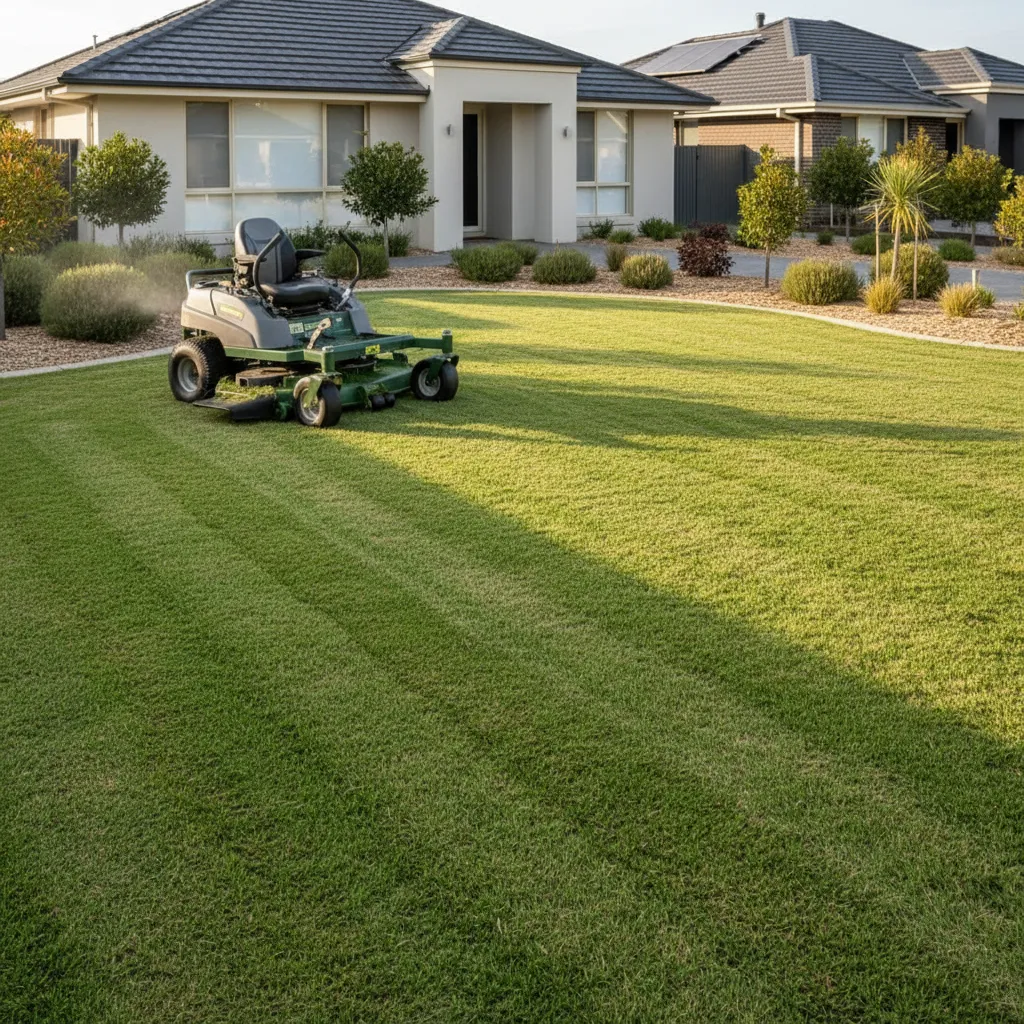
Lawn Care Calendar Sydney — Month by Month
What your lawn needs in every month of the Sydney year — mowing, feeding, aeration, dethatching and weed timing, set to your grass type. Plus the managed program that handles all of it for you.
Sydney lawns are almost entirely warm-season grasses — couch, kikuyu, buffalo and zoysia. They grow hard from September to March and sit close to dormant from June to August. Nearly every lawn care mistake made in this city comes from doing the right job in the wrong month: scalping in April, fertilising in July, scarifying a buffalo lawn at all.
This calendar sets out what to do and when, for the Sydney climate specifically. It covers the month-by-month schedule, the aeration and dethatching windows by grass type, and how a managed year-round lawn care program packages the whole thing.
Sydney Lawn Care Calendar — Month by Month
| Month | Key jobs |
|---|---|
| January | Mow weekly at summer height. Water deeply twice a week before 8am. Watch for army worm and lawn grub. |
| February | Mow weekly. Apply pre-emergent for winter grass and bindii before autumn germination. Assess thatch depth. |
| March | Mow fortnightly as growth slows. Core aerate. Autumn fertiliser with higher potassium. Overseed bare patches. |
| April | Mow fortnightly and start lowering height. Last window for light dethatching. Spot-spray broadleaf weeds. |
| May | Mow every three to four weeks. Rake fallen leaves off the lawn. Final feed before the lawn slows right down. |
| June | Mow monthly or as needed. Spray bindii and clover now, before the burrs harden. Do not fertilise dormant turf. |
| July | Mow only if growth warrants it. Never mow frosted or wet grass. Service the mower and sharpen the blade. |
| August | Late-winter pre-emergent for summergrass and crabgrass. Plan spring renovation work and book contractors. |
| September | Growth resumes. Return to fortnightly mowing. Balanced NPK spring fertiliser. Repair and re-turf bare areas. |
| October | Best month of the year for core aeration and dethatching. Top-dress after renovation. Mow fortnightly. |
| November | Peak growth. Mow weekly to fortnightly. Second window for scarifying couch and kikuyu. Water in fertiliser. |
| December | Raise the cutting height for summer. Slow-release feed early in the month. Check irrigation before holidays. |
Timing by Grass Type
The calendar shifts depending on what is actually growing in your yard. These are the four grasses that cover almost every Sydney lawn.
| Grass type | Mowing height | Aerate / renovate | Thatch notes |
|---|---|---|---|
| Couch (including Wintergreen, Santa Ana) | 10-25mm | October to December | Thatches heavily. Handles scarifying well and regrows fast from rhizomes. |
| Kikuyu | 25-40mm | October to January | Fastest thatch builder in Sydney. Tolerates aggressive dethatching and recovers in 2-4 weeks. |
| Buffalo (including Sir Walter) | 30-50mm | October to December | Spreads only by surface stolons. Core aerate, never scarify hard. Light vertimowing at most. |
| Zoysia (including Sir Grange, Nara) | 15-35mm | November to December | Dense and slow to recover. Dethatch only when necessary and allow 4-8 weeks. |
Not sure which grass you have? Buffalo has wide, folded leaf blades and runners that sit on top of the soil. Kikuyu has broad blades and thick, rope-like runners. Couch is fine-leafed and dense. Zoysia is fine-leafed but noticeably stiffer and slower to grow than couch.
Summer (December to February)
Mowing
Mow weekly, or fortnightly if growth slows in a dry spell. Raise the cutting height by roughly one setting to shade the soil and protect the crowns from heat stress. Never remove more than one third of the leaf blade in a single cut.
Watering
Water deeply two to three times a week before 8am rather than lightly every day. Deep, infrequent watering pushes roots down; shallow daily watering keeps them at the surface where they cook. Evening watering leaves the leaf wet overnight and invites fungal disease.
Fertilising
A slow-release fertiliser in early December carries the lawn through the growing season. Avoid heavy nitrogen during a heatwave: it forces soft, water-hungry growth that burns and attracts pests.
Weed control
Summergrass, crabgrass and nutgrass all move fast in December and January. Spot-treat or hand-pull, and keep the sward dense through regular mowing so weeds have nowhere to establish.
Pests
Army worm and lawn grub are the two that do real damage in a Sydney summer. The tell is a patch that browns off overnight, or birds working the same square metre repeatedly. Treat at first sign, not after the patch spreads.
Autumn (March to May)
Mowing
Drop back to fortnightly through March and April, then every three to four weeks in May. Lower the cutting height gradually as temperatures fall so the lawn does not go into winter long and floppy.
Fertilising
March or April is the right time for a fertiliser with higher potassium. Potassium thickens cell walls and improves cold and disease tolerance, which is what carries a warm-season lawn through a Sydney winter.
Aeration
Early autumn is the second-best aeration window of the year in Sydney, behind spring. Soil is still warm enough for the lawn to knit the holes closed before growth stops. Leave at least six weeks between aeration and the first cold snap.
Dethatching
March is workable for a light dethatch on couch and kikuyu if thatch built up over summer. By late April the recovery window has closed for the year: an aggressive autumn scarify leaves bare soil that will not fill in until September.
Weed control
February and March is the pre-emergent window for winter grass (Poa annua) and bindii, before they germinate. Miss it and you are spraying burrs in June instead.
Winter (June to August)
Mowing
Monthly, or simply when it needs it. Keep the blade sharp: a blunt blade tears cold grass rather than cutting it and the ragged tips brown off. Never mow wet or frosted turf.
Watering
Cut watering right back. Sydney winters are mild and warm-season lawns are close to dormant. Water only through an extended dry spell of three weeks or more.
Fertilising
Do not feed a dormant lawn. The grass cannot use it, the nitrogen leaches or burns, and the money is wasted. Wait for growth to resume in September.
Weed control
June and July is the window to spray bindii, before the burrs harden and set seed. Broadleaf weeds are also easy to spot in winter because the lawn around them is not growing over the top of them.
Maintenance and planning
Service the mower, sharpen or replace the blade, check irrigation heads and plan any spring renovation. Aeration, dethatching and returfing all book out quickly once September arrives.
Spring (September to November)
Mowing
Resume fortnightly mowing in September. Bring the cutting height back down over three or four mows rather than in one scalping cut, which strips the lawn of leaf just as it is trying to grow.
Fertilising
A balanced NPK or higher-nitrogen starter in September or October, once soil temperatures are consistently above 18C. Water it in. Feeding before the soil warms simply feeds the weeds.
Aeration and dethatching
October is the single best month of the year for both jobs in Sydney. The lawn is growing hard, soil moisture is usually good, and there are months of growing season left for full recovery.
Weed control
Apply pre-emergent for summergrass and crabgrass in late August or early September, before soil temperatures reach about 15C. Do not aerate after applying pre-emergent: coring breaks the chemical barrier you just laid down.
Repairs and bare patches
September and October is the window for levelling, top-dressing, overseeding and laying new turf. Warm soil and spring rain give new roots time to establish before summer heat arrives.
Aeration and Dethatching — When, Why and Which One
These are the two jobs on the calendar that make the biggest visible difference to a tired lawn, and they are also the two most often confused with each other. They fix different problems, use different machines and are not interchangeable.
Aeration deals with the soil. Dethatching deals with the layer of dead organic matter sitting on top of it. A lawn can need one, the other, both, or neither.
Core aeration versus spike aeration on Sydney clay
Core aeration pulls hollow plugs of soil out of the lawn, typically 50 to 75mm deep and 10 to 20mm across. Removing that soil is the whole point: it gives the compacted soil around each hole somewhere to expand into, and it opens a direct path for water, air and fertiliser down to the root zone.
Spike aeration, whether from a solid-tine machine or a pair of spiked sandals, does not remove anything. It pushes a solid point into the ground and displaces the soil sideways, which compresses the wall of the hole. On sandy soil that is a minor issue. On the shrink-swell clays derived from Wianamatta shale that sit under most of Western Sydney — Parramatta, Blacktown, Penrith, Wentworthville — spiking a compacted lawn can genuinely leave it worse than before.
That is why core aeration is the default recommendation across most of Sydney. The sandstone-derived sandy soils closer to the coast and the harbour compact less and drain freely, and those lawns often benefit more from a wetting agent and organic matter than from annual coring.
Two tests that tell you which job your lawn needs
The screwdriver test, for compaction. Water the lawn, wait a day, then push a 150mm screwdriver into the soil using hand pressure alone. If it slides most of the way in, the soil is in reasonable condition. If it stops dead in the first 50mm, the lawn is compacted and needs aerating. Other signs: water pooling or running off after rain, bald strips along the paths people actually walk, moss in shaded areas, and roots that stay in the top few centimetres.
The spade wedge, for thatch. Cut a small triangular wedge out of the lawn with a spade and look at the side of it. Between the green leaf and the soil you will see a brown, fibrous layer of dead and living stems, stolons and roots. Under 10mm of that is healthy — it insulates the crowns and holds moisture. Between 10 and 20mm, keep an eye on it and top-dress. Over 20mm and the lawn needs dethatching: at that depth the roots start growing into the thatch instead of the soil, which is why thatchy lawns dry out fast, scalp when you mow and feel spongy underfoot.
Scarifying, dethatching and vertimowing are not the same thing
The three terms get used interchangeably in Australia, which causes real damage when the wrong machine turns up.
- Dethatching or power raking uses spring tines or flails that comb loose, dead material out at soil level. It is the gentlest of the three and lifts surface debris rather than cutting into the lawn.
- Vertimowing runs fixed vertical blades set to just nick the top of the thatch layer. It reduces thatch and encourages upright growth without opening the lawn up. This is the correct setting for buffalo.
- Scarifying runs those same vertical blades down through the thatch and into the soil surface, cutting stolons and removing thatch wholesale. It is a renovation, not a tidy-up, and it leaves the lawn looking wrecked for weeks before it comes back thicker.
Why buffalo is the exception
Couch, kikuyu and zoysia all spread by underground rhizomes as well as surface stolons. Cut the surface runners off and there is still a network below ground that pushes new shoots up. That is why couch and kikuyu can be scarified hard in October and be back inside a month.
Buffalo, including Sir Walter, has no rhizomes at all. It spreads purely by stolons running across the surface. A scarifier that cuts those stolons out removes the plant's only means of regrowing, and the bare patch simply stays bare. Buffalo lawns should be core aerated, vertimowed lightly at most, and then top-dressed with a sandy loam and mown at 30 to 50mm. Thatch on buffalo is managed over seasons, not stripped out in an afternoon.
What actually happens on the day
The lawn is mown short first and the clippings taken away, so the machine is working on the thatch and soil rather than on long leaf. Irrigation heads, shallow pipes and any cabling get marked before anything with tines goes over them.
Soil moisture matters more than most people expect. Bone-dry Sydney clay is hard enough that hollow tines will bounce rather than penetrate; saturated soil smears and seals instead of coring cleanly. A decent soak one or two days before the job is the sweet spot, which is why we ask for it at booking.
Core aeration is normally run as two passes at right angles to each other so the hole pattern is even. The plugs can be left on the surface to break down over a week or two, which effectively top-dresses the lawn for free, or collected if you want a clean finish straight away. Scarified thatch is always collected and removed — leaving it on the lawn defeats the purpose.
Fertiliser goes on afterwards, while the holes are still open and can carry it to the root zone, along with top-dressing sand or a soil blend if the surface needs levelling. Then the whole thing gets watered in.
Recovery and what to expect afterwards
Core aeration is cosmetically mild. The lawn looks like a flock of birds has been at it for about a week, the cores crumble away within one to two weeks, and it is fully knitted back together in two to four weeks during the growing season.
Dethatching and scarifying look far worse. Expect brown, thin turf with visible soil, and expect it to look wrong for a fortnight. Kikuyu and couch recover in two to four weeks in October. Buffalo takes four to six weeks after a light vertimow. Zoysia is the slowest at four to eight weeks, which is why it is only worth doing on zoysia when the thatch is genuinely excessive.
Aftercare is simple and it matters: water lightly and often for the first fortnight rather than deeply and rarely, keep foot traffic and pets off, hold off on any herbicide until the lawn has closed over, and raise the height slightly for the first mow back. One more thing worth knowing — core aeration breaks the chemical barrier a pre-emergent herbicide relies on, so aerate first and spray after, never the other way around.
The Managed Lawn Care Program
If you would rather not track any of this yourself, a lawn care program runs the calendar for you. It is the same schedule set out above, turned into scheduled visits, with the seasonal treatments booked in their correct windows rather than whenever someone remembers. No lock-in contracts.
Spring program (Sep to Nov)
- First mow of the season at the correct height for your grass type
- Core aeration to relieve winter compaction
- Balanced NPK fertiliser, watered in
- Pre-emergent for summergrass before soil temperatures climb
- Edge definition and border refresh
- Mowing frequency lifted to fortnightly as growth accelerates
Summer program (Dec to Feb)
- Weekly to fortnightly mowing, adjusted to actual growth
- Cutting height raised through heat waves
- Monitoring and treatment for lawn grub and army worm
- Edge trimming and blow-down on every visit
- Irrigation advice for the property and any water restrictions
- Thatch depth assessed and flagged for autumn treatment
Autumn program (Mar to May)
- Mowing frequency reduced as growth slows
- Potassium fertiliser to harden the lawn for winter
- Core aeration, or light dethatching where thatch exceeds 20mm
- Pre-emergent for winter grass and bindii in February and March
- Overseeding of bare patches while the soil is still warm
- Final edge definition before the slow winter period
Winter program (Jun to Aug)
- Monthly mowing, or by condition rather than by calendar
- Bindii and broadleaf weed spraying in June and July
- Monitoring for fungal disease in cool, damp conditions
- Leaf clearing so the lawn is not smothered
- Mower servicing and irrigation checks
- Spring renovation scheduled and booked in August
Frequently Asked Questions
Seasonal timing, aeration, dethatching and how a managed lawn care program works in Sydney.
When is the best time to aerate a lawn in Sydney?
October is the best month, with the window running from roughly late September through to December. Warm-season grasses need to be actively growing to close the holes and recover, which means soil temperatures consistently above about 18C. Early autumn, particularly March, is the second-best option. Aerating in winter achieves nothing because the lawn is not growing enough to respond.
What is the difference between core aeration and spike aeration?
Core aeration uses hollow tines to pull plugs of soil out of the lawn, typically 50 to 75mm deep. Removing that soil gives the surrounding compacted soil somewhere to expand into, which is what actually relieves compaction. Spike aeration pushes a solid tine in and displaces soil sideways, compressing the wall of the hole. On the heavy shale-derived clay found across much of Western Sydney, spiking can leave the soil worse than it started. Core aeration is the right tool on clay.
How do I tell whether my lawn needs dethatching or aerating?
They solve different problems, so check for both. For thatch, cut a small wedge out with a spade and look at the layer of brown stems and stolons between the green leaf and the soil. Under 10mm is healthy and protective. Over about 20mm is a problem and needs dethatching. For compaction, push a screwdriver into moist soil with hand pressure. If it goes in 150mm easily, the soil is fine. If it stops in the first 50mm, the lawn needs aerating. A spongy lawn that scalps easily has thatch. A hard lawn that puddles after rain and thins along walking lines is compacted.
What does scarifying actually do to a lawn?
A scarifier runs fixed vertical blades down into the thatch layer and slightly into the soil surface, cutting out thatch and slicing through stolons. It is the most aggressive of the three thatch treatments. A dethatcher or power rake uses spring tines or flails to comb loose dead material out at soil level. Vertimowing, or vertical mowing, is the light version, set to nick the top of the thatch and encourage upright growth without a full renovation. Scarifying a buffalo lawn hard can kill it, because buffalo has no underground rhizomes to regrow from.
Can you dethatch a Sir Walter buffalo lawn?
Not the way you would dethatch couch or kikuyu. Buffalo, including Sir Walter, spreads only by above-ground stolons. It has no rhizomes underground, so if a scarifier cuts the stolons out there is nothing left to regrow from and the bare patch stays bare. The right approach on buffalo is core aeration plus a light vertimow at most, followed by top-dressing with a sandy loam and correct mowing height. Thatch on buffalo is managed rather than stripped.
What happens on the day of a lawn aeration or dethatching job?
The lawn is mown short first and the clippings removed. Irrigation heads, shallow pipes and cabling are marked so nothing gets punched through. The soil needs to be moist but not saturated, so we usually ask for a decent water a day or two beforehand: bone-dry clay will not let the tines penetrate, and waterlogged soil smears rather than cores. Core aeration is normally run in two passes at right angles. The cores are either left on the surface to break down as a natural top-dressing or collected, depending on the finish you want. Scarified thatch is always collected and removed. Fertiliser and top-dressing go on afterwards and everything is watered in.
How long does a lawn take to recover after aeration or dethatching?
Core aeration looks messy for about a week. The cores crumble within one to two weeks and the lawn is fully back within two to four weeks in the growing season. Dethatching is far more dramatic: expect a brown, thin lawn that looks worse before it looks better. Kikuyu and couch bounce back in two to four weeks, buffalo takes four to six weeks after a light vertimow, and zoysia can take four to eight weeks. Keep the water up, keep traffic off, and do not apply herbicide while the lawn is recovering.
How often should a Sydney lawn be mown?
Weekly in summer through peak growth, fortnightly in spring and autumn, and monthly or by condition through winter. The rule that matters more than the calendar is the one-third rule: never remove more than a third of the leaf blade in one cut. If the lawn has got away from you, bring it down over two or three mows a few days apart rather than scalping it in one go.
What does a year-round lawn care program include?
A Jay Pro lawn care program covers mowing at the correct height for your grass type, edge trimming and blow-down on every visit, seasonal fertilising (balanced NPK in spring, potassium in autumn), annual core aeration, dethatching when thatch depth warrants it, and weed management timed to the germination windows rather than to complaints. The schedule shifts through the year to match Sydney growth patterns instead of running the same visit every fortnight regardless of season.
How is a lawn care program different from regular lawn mowing?
A mowing service cuts, edges and blows down. A lawn care program does that and adds the seasonal work that actually determines whether the lawn is healthy: aeration, fertilising, thatch management and correctly timed weed control. Mowing keeps a lawn tidy. The program work is what keeps it thick, green and able to handle a Sydney summer.
Is there a lock-in contract on a lawn care program?
No lock-in contracts. You can adjust, pause or cancel at any time. Most customers stay because the lawn visibly improves, not because they are tied in.
How much does a lawn care program cost in Sydney?
It depends on property size, grass type, current condition and which seasonal treatments you want included, so we do not publish a rate that would be wrong for most properties. Call 0468 049 230 or request a free quote online and we will give you an exact price for your property before any work begins.
Book the Work on the Calendar
Let Jay Pro Run the Calendar for You
Mowing, aeration, dethatching and seasonal feeding, scheduled in the right months across 250+ Sydney suburbs. Call 0468 049 230 or request a free quote online — we will give you an exact price for your property before any work begins.
2,100+ Customers | Licensed & Insured | Same Day Service